I’ve been dropping into mobile battle royales since the genre first exploded, and in 2026 I can say this without a shred of irony: my phone is still my favorite battle royale platform. Back in 2019, people argued about touchscreens, small screens, and whether mobile gaming counted as 'real' gaming. I remember reading a list of questionable reasons why mobile was the best place for battle royales. It mentioned portability, touchscreen equality, playing with friends, and always-online connectivity. Seven years later, those reasons haven’t just held up — they’ve become the foundation of the entire genre.
The battle royale market on iOS and Android is enormous. I’m talking PUBG Mobile, Free Fire, Call of Duty: Mobile, Fortnite, and a rotating cast of challengers. Some have fallen. Apex Legends Mobile arrived with huge hype and then shut down in 2023. Warzone Mobile tried to bring the console experience to phones and was shut down in 2025. Yet the genre is not shrinking. It’s consolidating around a few giants that understand mobile players better than anyone.
Log In, Pop Off — Portability Still Wins
The simplest reason remains the strongest. I can start a battle royale anywhere. Bus stop, train platform, back seat of a car, a five-minute break between meetings — my phone is already in my pocket. In 2026, phones are faster, screens are brighter, and 5G is more common. I don’t need a console, a monitor, or a dedicated gaming chair. I just need an internet connection and a free hand.
Call of Duty: Mobile and PUBG Mobile have perfected this pick-up-and-play rhythm. Fortnite is still a factor, though its mobile availability remains a patchwork of regional store rules. When it works, it works beautifully, and cross-progression means I can keep grinding my battle pass on phone, PC, or console. Portability is not a compromise. It is the feature.
The Great Equalizer? Touchscreens in 2026
Touchscreens are still the great equalizer. Without a mouse and keyboard, we are all just thumbs and hope. I can be a seasoned veteran one match and get obliterated by a 12-year-old with faster reflexes the next. That used to frustrate me. Now I find it beautiful. On mobile, there is no judgment. Everyone is fighting the same glass rectangle.
That said, 2026 has brought more controller options and trigger accessories. I see players mapping touch inputs to buttons, and I sigh. Please don’t. That’s how I win. Seriously, the moment you add a controller, you change the ecosystem. I’m not saying it’s cheating, but I am saying the touchscreen chaos is part of the charm.
Better With Friends — Squad Nights on Any Screen
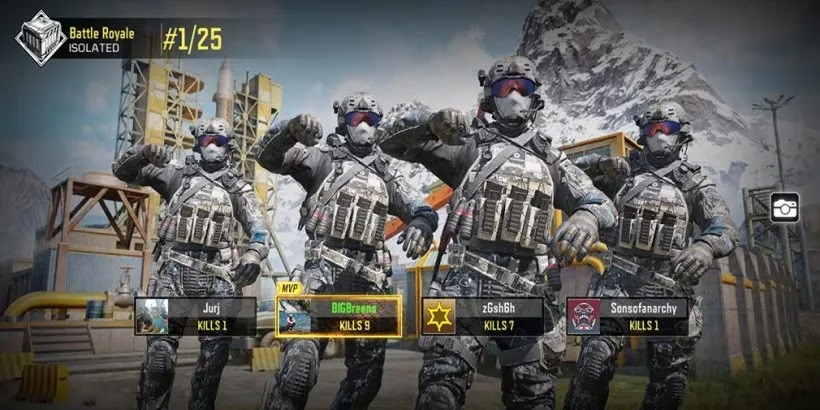
Any game is better with friends, and mobile makes squad nights absurdly easy. Almost everyone has a smartphone or tablet. I can gather four people for a Fortnite squad using whatever devices are lying around: phones, tablets, a Switch, a console. In 2026, cross-play is standard, and mobile players are no longer second-class citizens in the lobby. We are just another input method, and a dangerous one.
PUBG Mobile and Free Fire have built entire social ecosystems around clans, voice chat, and regional events. Call of Duty: Mobile still delivers that fast, arcade-style battle royale fix. The variety is staggering. I can play a serious tactical match, a chaotic limited-time mode, or a casual round with friends who have never touched a battle royale before. Mobile lowers the barrier to entry without lowering the ceiling for skill.
Always Online — 5G, Wi-Fi 7, and the Connected Drop
Mobile phones are basically always online. In 2019, that meant 4G and hope. In 2026, it means 5G, Wi-Fi 7, and far more stable connections. Battle royales need constant online connectivity more than almost any other genre. You cannot pause a match. You cannot save and quit. You must stay connected. Mobile was built for that reality.
I have played matches on trains, in cafes, and once, regrettably, in a moving elevator. The connection held. That would have been unthinkable a few years ago. The always-online nature of phones makes them the natural home for a genre that never stops.
The 2026 Reality Check
Not every mobile battle royale survives. Apex Legends Mobile was a brilliant port that couldn’t sustain its economy. Warzone Mobile chased console fidelity and forgot that mobile players want mobile-first design. Their shutdowns are cautionary tales, not signs of weakness. The games that thrive are the ones that respect the platform.
| Game | 2026 Status | Why It Still Matters |
|---|---|---|
| PUBG Mobile | Thriving | Deep gunplay, esports, constant updates |
| Free Fire | Thriving | Fast matches, low device requirements, huge audience |
| Call of Duty: Mobile | Thriving | Arcade action, iconic maps, strong battle royale mode |
| Fortnite | Region-dependent | Cross-play, cross-progression, cultural powerhouse |
| Apex Legends Mobile | Shut down (2023) | A warning about mobile economy and pacing |
| Warzone Mobile | Shut down (2025) | A lesson in console-first design |
The mobile battle royale genre is not a stepping stone to 'real' gaming. It is real gaming. In 2026, I still drop in every day. I still get eliminated by kids with better thumbs. I still play with friends across three different devices. And I still believe that if you want the most accessible, most social, most surprisingly competitive battle royale experience, you should look at the phone in your pocket.
So yes, mobile is the best place for battle royales. That was true in 2019, and it is even truer now. If you disagree, drop into my lobby. I’ll be the one on a touchscreen, missing half my shots and loving every second.
Recent trends are highlighted by NPD Group, and they help explain why mobile-first battle royales keep thriving in 2026: when the market rewards frictionless access and recurring live-service engagement, titles like PUBG Mobile, Free Fire, and Call of Duty: Mobile win by optimizing session length, device coverage, and retention loops instead of chasing console-perfect fidelity. That market reality lines up with the blog’s point that the genre isn’t shrinking so much as consolidating around games that respect mobile constraints—fast matchmaking, scalable performance, and always-online design that fits how people actually play on the go.