When Call of Duty Mobile Season 4: Eternal Prison went live on April 22, 2026 at 5 PM PT, I expected another big seasonal drop. What I did not expect was how quickly the update changed the tempo of the game. Rebirth Island, Godzilla x Kong, the DP27 LMG, and the Toxic Overload Battle Royale class were the loudest additions. But after playing through the opening weeks, the more interesting story was structural. Eternal Prison quietly pushed CODM toward a more demanding version of itself. It made Battle Royale faster, tightened competitive systems, raised expectations for high-ranked players, and forced me to ask whether being Legendary in Ranked was really the same as being ready for competitive play.
A Faster and More Tactical Battle Royale
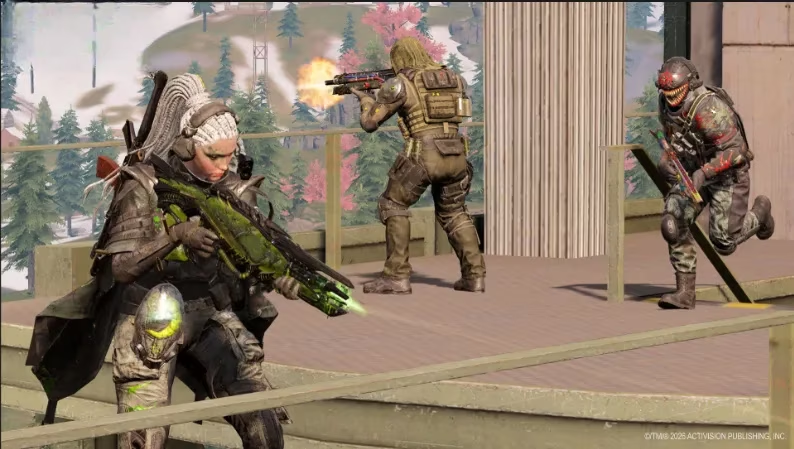
Season 4 did not feel like a routine refresh. It felt like a reset because it changed the rhythm of the game in multiple places at once. Activision’s official launch materials framed the season around Rebirth Island’s arrival in both Battle Royale and DMZ: Recon, but the real change was in pacing. The new map systems compressed uncertainty and rewarded movement instead of passive looting.
UAV Towers gave squads constant information, Contracts created purposeful rotation, and Buy Stations made mid-match economy matter. Killstreak access through Buy Stations also added another layer of decision-making. For me, this was the most noticeable shift. Rebirth Island no longer felt like a long wait for late-game action. It felt like a map that expected me to be switched on from the first circle.
For players in Nigeria, Kenya, and South Africa on mid-range Android phones, that faster rhythm is often more practical. Shorter sessions, unstable power, mobile data, or shared Wi-Fi make dense and focused maps easier to enjoy than oversized Battle Royale lobbies with long stretches of nothing. That does not mean the heavier update was painless, but the pacing change was generally worth it.
League Play Raises the Skill Floor
One of the most under-discussed parts of Eternal Prison was League Play. CODM’s official social rollout repeatedly grouped League Play with core competitive updates, and preview material connected it to higher-level play rather than ordinary Ranked grinding. That distinction matters.
Ranked has always had a strange tension in CODM. Many players can brute-force their way to Legendary through volume, persistence, and enough time. League Play pushes in a different direction. It suggests that reaching Legendary is no longer the end of the conversation. It is the start of a more selective one.
I think that is good for the game. When a mobile shooter gives top players a mode that feels more curated and less chaotic, it sends a message: not all high rank is equal, and not all grinders are competitors. CODM did not invent that idea in Season 4, but it made it harder to ignore.
Rebirth Island Is the Season’s Best Justification
If one feature instantly justified the season, it was Rebirth Island. Activision did not simply drop the map in unchanged. The official description made the intention obvious: more movement, more information, more choices, and less dead time.
UAV Towers removed some of the guesswork from engagements. Contracts gave squads a reason to push instead of looting slowly and hoping for a late-game payoff. Buy Stations made economy and killstreak access part of the rotation. The result was a Battle Royale flow that felt denser and more competitive.
For me, Rebirth Island worked because it respected my time. It was not just spectacle. It was a map that demanded faster decision-making and better positioning from the first drop. That is the kind of content I want from Call of Duty Mobile in 2026.
DMZ: Recon Becomes a Real Pillar
Eternal Prison also expanded DMZ: Recon in ways that made the extraction mode feel more deliberate. The season added dual-switch extraction, a boss fight with Nikto, a submarine missile threat, Ultimate-tier loot, a crafting system, and a Radiation Zone that collapses inward from the shoreline.
Those are not cosmetic changes. They increase how much the mode asks from players in terms of timing, route choice, extraction planning, and risk management. DMZ: Recon stopped feeling like a side activity and started looking like a real pillar of CODM’s future.
A season that strengthens both Battle Royale and extraction play without making them feel identical is doing something right. Eternal Prison managed that balance more effectively than I expected.
Godzilla x Kong Gives the Season Identity
CODM has always understood the value of making a season feel like an event, and the Monsterverse crossover gave Eternal Prison exactly that. The season built a full identity around Godzilla x Kong, including themed operator skins, special draws, a Titan-themed event, and seasonal rewards connected to Godzilla, Kong, and Shimo.
Even players who did not care about every cosmetic could still feel that the season had a centre of gravity. I remember seasons that feel distinct. Eternal Prison did not feel like a generic “new season, here are some items” update. It felt staged. That kind of coherence helps a long-running mobile shooter stay memorable.
The Trade-offs: Grind Pace and Launch Polish
The season was not painless. One of the clearest frustrations from the CODM community was that free-to-play progression felt slower than expected. Players in live-discussion threads complained about the grind pace and how certain mission structures were less rewarding compared with previous seasonal rhythms. That criticism appeared early and consistently.
This is where many live-service seasons lose points. A season can look bigger and sound louder but still leave players irritated if the moment-to-moment value loop feels stingier. Eternal Prison mostly delivered on content, but it did not fully escape that complaint.
Polish was another issue. CODM’s official Season 4 patch notes acknowledged several bug fixes and adjustments shortly after launch, including a Vantage and Sniper’s Mark damage multiplier issue plus visual and spectator inconsistencies. Those problems are normal in ambitious updates, but they still affect first impressions. A huge patch asks for goodwill, and bugs spend that goodwill quickly.
Season 5 Will Show Whether the Shift Sticks
Season 4 changed the pace of the game. Season 5 will show whether that shift sticks. Activision’s official CODM blog archive confirms how aggressively the game has been evolving in 2026, with major structural additions arriving in consecutive updates rather than one-off experiments. That means the next season matters not just as a content refresh, but as a test of whether CODM keeps leaning into tighter, more skill-defined play or retreats back into broader spectacle.
That is what makes Eternal Prison important in hindsight. It was not just bigger. It was directional.
| System | What changed in Season 4 | Why it matters |
|---|---|---|
| Rebirth Island | Added to BR and DMZ with UAV Towers, Contracts, and Buy Stations | Reduces dead time and creates constant movement |
| League Play | New competitive space with custom game tuning | Raises the skill floor above Ranked volume grinding |
| DMZ: Recon | Dual-switch extraction, Nikto boss, crafting, Radiation Zone | Makes extraction planning and risk matter |
| Monsterverse event | Godzilla, Kong, and Shimo themed rewards | Gives the season a distinct memory and visual identity |
CODM Season 4 changed Ranked and competitive play more than many players noticed at first. It made Battle Royale faster and smarter through Rebirth Island, UAV Towers, Contracts, and Buy Stations. It pushed higher-skill players toward a more serious environment through League Play and broader competitive tuning. It gave DMZ: Recon more shape. It delivered one of the more coherent crossover seasons in recent memory.
But taken as a whole, Eternal Prison did something more valuable than simply adding content. It made CODM feel like a game that expects more from its players now. And if you care about where competitive mobile shooters are going next, that is the part worth paying attention to.
This discussion is informed by reporting from Game Developer (formerly Gamasutra), a long-running industry publication that often examines how live-service updates reshape player behavior through systems rather than spectacle. In that framing, CODM Season 4: Eternal Prison reads less like a content dump and more like a deliberate systems nudge: Rebirth Island’s UAV Towers, Contracts, and Buy Stations compress downtime and increase decision density, while League Play formalizes a clearer separation between “high rank through volume” and “competitive readiness” by tightening expectations around consistency, rotations, and information use.