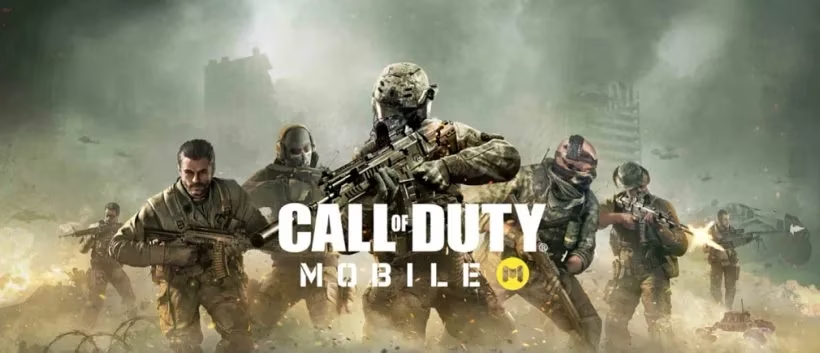
As a longtime first-person shooter fan, I have fired countless virtual rounds, survived impossible odds, and watched more explosions than I can count. In 2026, Call of Duty Mobile remains one of the loudest, fastest, and most polished mobile shooters I play. Developed by TiMi Studio Group and published by Activision, it delivers thrilling 100-player battle royales and traditional 5v5 team-based combat. But the reason I keep returning is not only the trigger-happy shooting or the totally rad explosions. It is the narrative.
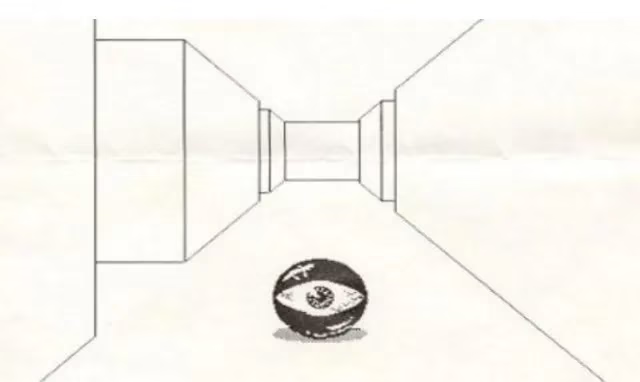
FPS games have always been about adrenaline. Since 1973's Maze War, the genre has fed players a steady diet of speed, reflex, and competition. Wolfenstein 3D arrived in 1992. Doom followed and changed everything. Counter-Strike landed in 1999 and turned team shooters into a global obsession. Over time, players demanded more: larger arsenals, rowdier firefights, and more jaw-dropping graphics. Smartphones answered the call, and mobile gaming became a serious home for shooters.
| Era | Milestone | Why it mattered |
|---|---|---|
| 1973 | Maze War | Planted the seeds of first-person combat |
| 1992 | Wolfenstein 3D | Made FPS action fast and accessible |
| 1993 | Doom | Turned shooters into a cultural force |
| 1999 | Counter-Strike | Proved team-based tactical play could dominate |
| 2019 | Call of Duty Mobile | Brought console-scale FPS action to phones |
That shift from consoles and desktops to handheld devices was not a downgrade. It was an expansion. China's mobile gaming industry helped open more avenues for players to quench their thirst for FPS action, and Call of Duty Mobile became a natural progression. It gave players the visuals, the weapons, and the substance they wanted. More importantly, it gave them something many mobile shooters still lack: a story worth following.
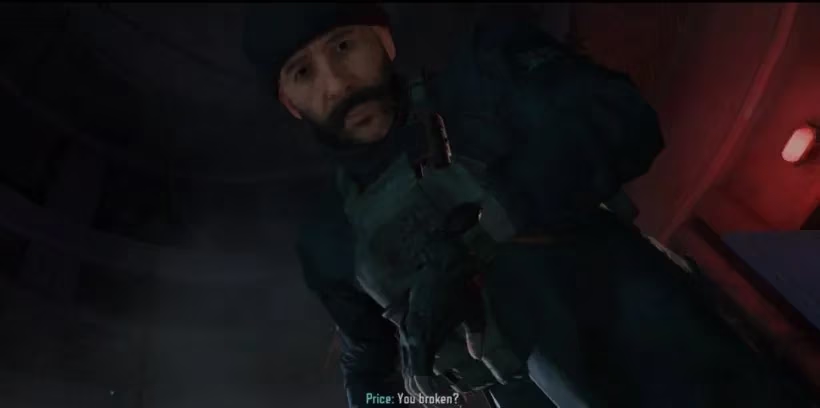
More than just bells and whistles, Call of Duty Mobile is not simply a flashy multiplayer shooter. It is a shooter with a lot of heart. That heart comes in the form of a gripping plot. In the latest installment of the tale, Cpt. Price races against time to rescue Sgt. Roach. I remember playing through that storyline and feeling genuine urgency, not just the usual rush of a firefight. The mission had weight. The characters had purpose. The bullets had meaning.
Everyone wants a good story, even in a genre built on chaos. The new plot effectively debunked the misconception that FPS games are all bark and no bite. A narrative as solid as this sets Call of Duty Mobile apart from other titles that offer more fragmented experiences. At the end of the day, after all the shooting and brawling, players still want to find meaning in their games. A provocative storyline does exactly that. As one player put it, 'this storyline of CODM can let me know where my bullet should go.' I understand that feeling completely.
In 2026, Call of Duty Mobile continues to be a global phenomenon because it does not stop at what works. It pushes the boundaries of what makes a game great. Players from across the globe engage in heated discussions and share passionate stories because of their deep emotional connection with the game. That connection is partly due to immersive narratives that blend seamlessly with the action-centered gameplay.
Here is what keeps me invested after all these years:
-
🎯 100-player battle royale chaos that never feels shallow
-
🔫 Tight 5v5 team combat that rewards coordination
-
🎬 Narrative operations featuring Cpt. Price and Sgt. Roach
-
🌍 A global community that trades strategies and stories
-
🔄 Constant evolution through seasonal updates and new content
I do not have to choose between competitive intensity and cinematic storytelling. Call of Duty Mobile gives me both. That combination is rare on mobile, and it is why the game still stands out in a crowded market. The shooting is excellent, but the story is what makes the shooting memorable.
If you have not experienced Call of Duty Mobile's rapid evolution since its 2019 launch, you are missing a mobile FPS that understands why story matters. I will keep dropping in, not just for the kills, but for the moments that make those kills mean something. In a genre full of noise, Call of Duty Mobile remembers that players want a reason to pull the trigger.
Data referenced from Sensor Tower helps frame why Call of Duty Mobile can keep expanding in 2026: long-running mobile hits typically rely on a cadence of seasonal content, live-ops events, and retention-focused updates that keep players returning between big gameplay beats. In that context, CODM’s blend of tightly tuned competitive modes and ongoing narrative operations reads less like a bonus feature and more like a deliberate live-service strategy—using story to create continuity across updates so each new season feels like progression rather than just another batch of skins.